
Why We Built PowerPost: One Multi-Platform Social Media Content Tool Instead of Five
July 8, 2026 · 6 min read
Most social media tools were built to schedule posts. AI showed up a couple of years later, so they bolted a caption box onto the sidebar and called it a feature.
That's the whole reason PowerPost exists. We think a multi-platform social media content tool should actually make the content, then publish it everywhere, in one place. The captions. The images. The video. Not hand you an empty scheduling slot and wish you luck. The making and the posting are the same job. Splitting them across five apps was never the plan. It's just where the old tools started, and they never left.
Here's what that means, and why we bet a company on it.
The current landscape is a scheduler with AI taped to it
Open up Buffer, Later, or Hootsuite and you'll notice the same thing. The core product is a calendar and a queue. Everything else is an add-on.
Buffer's AI writes text and nothing else. Hootsuite can spit out an image but not video. Later built its whole calendar around the Instagram grid, so the moment you try to schedule a LinkedIn carousel or a YouTube Short, it feels like a guest in someone else's house. And the features most people actually want, like caption writing or image generation or video, either sit behind an enterprise tier or aren't there at all.
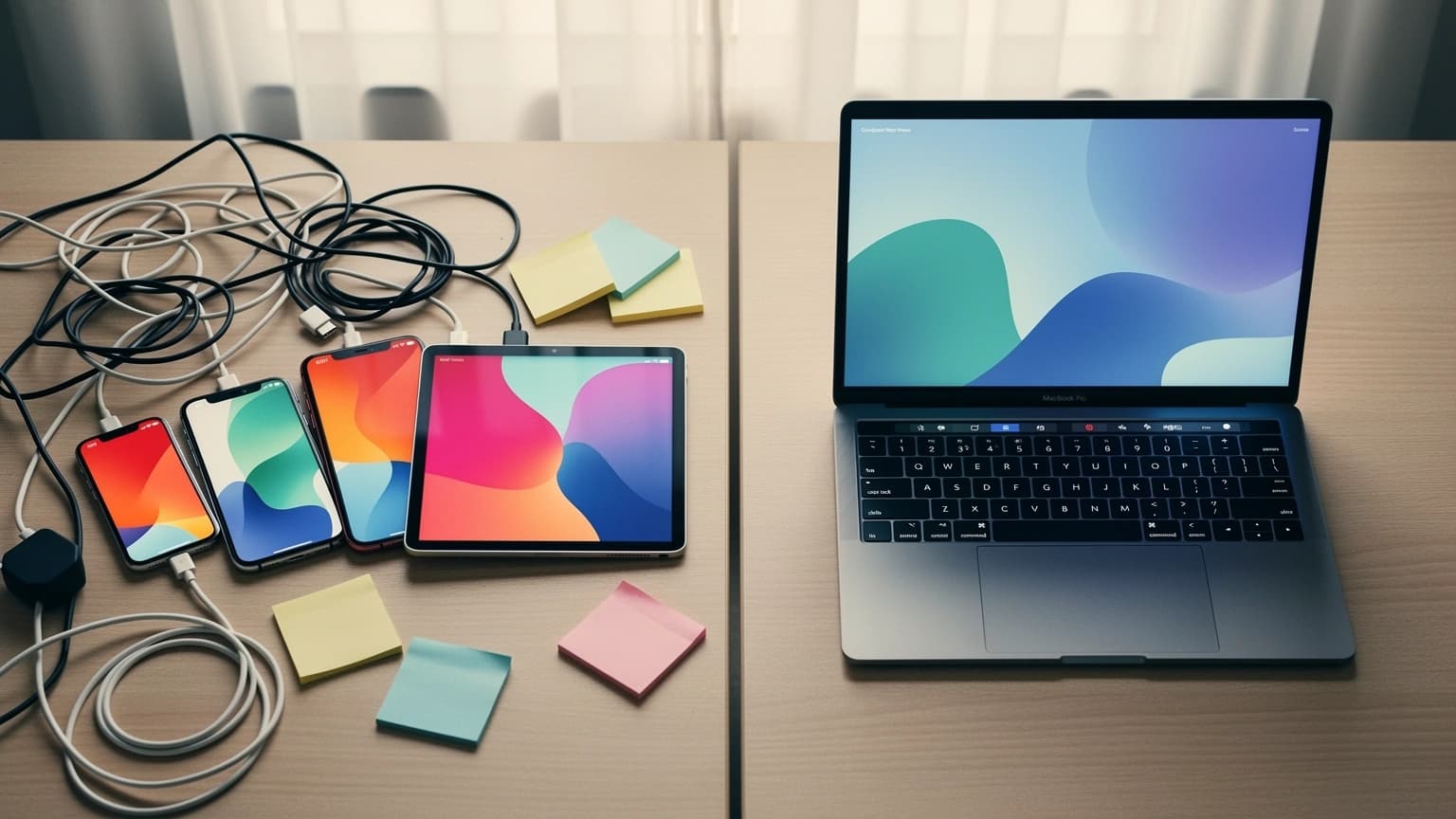
So you end up with a stack. A scheduler for posting. ChatGPT for captions. Canva for graphics. Something else for video. A spreadsheet to keep it all straight. Each one is fine on its own. Together they're a tax you pay every single day.
That tax is real, and people have measured it. In one survey of 1,000 knowledge workers, people bounced between tabs and apps about 33 times a day and lost roughly 44 hours a year just to tool fatigue. For a solo creator or a small team, that's not a rounding error. That's the difference between posting consistently and giving up by Thursday.
What we believe instead
Creating a post and publishing a post are one motion, not two.
When you sit down to make content, you're not thinking "first I'll write, then I'll design, then I'll schedule." You're thinking about the idea. The tool should carry that idea all the way from a blank page to live on five platforms without making you export, re-import, reformat, and log back in four times along the way.
We also believe AI belongs at the center, not on the side. Nearly nine in ten marketers already use generative AI for content, and almost everyone else plans to this year. That's not a trend you bolt onto an old product. It's the product. If we were starting a content tool in 2026 and AI wasn't the engine, we'd be building a fax machine with a nicer font.
And every platform should be a first-class citizen. Instagram, TikTok, X, Facebook, YouTube. None of them is the "main" one that everything else bends around. A caption that sings on X will flop on LinkedIn. A vertical video cut for TikTok gets cropped weird in a feed. Handling that shouldn't be your job. It should be the tool's.
What a multi-platform social media content tool looks like in practice
One workflow. Start with an idea. Generate the caption, tuned per platform. Generate the image or the video right there, no jumping to a separate app. Set your brand voice once with a writing style, and every caption comes out sounding like you instead of like a robot's idea of you. Then publish to Instagram, TikTok, X, Facebook, and YouTube, or drop it on the content calendar for later.
No export. No re-import. No five tabs. The AI generation, the image and video, the publishing, the calendar, the brand voice. It's one tool doing one job, which is getting your idea in front of people.
If you've ever rewritten the same caption five times for five platforms, you already know exactly which problem we started with.
Why not just use a scheduler that already has AI?
Because "has AI" and "is built around AI" are completely different products. A scheduler that added a caption button is still a scheduler, and the AI is a guest. When the generation, the media, and the publishing are designed together from day one, the whole thing moves differently. You feel it the first time you take an idea to five live posts without opening another tab.
Can't I just glue ChatGPT, Canva, and a scheduler together?
You can, and plenty of people do. It works, right up until it doesn't. Every handoff between tools is a place to lose the thread, break your brand voice, or just run out of energy. The glue is the work. We'd rather you spend that energy on the idea and let one tool handle the plumbing. If you want the honest math, we added up how much time that stitching quietly eats.
FAQ
Is PowerPost just another AI caption generator?
No. Caption generation is one piece. PowerPost also generates images and video, publishes to five platforms, holds your brand voice across everything, and runs a content calendar, all in the same place. The caption is where a lot of tools stop. It's where we start.
Which platforms does PowerPost publish to?
Instagram, TikTok, X, Facebook, and YouTube, from a single workflow, with the content shaped for each one instead of copy-pasted across all of them.
Do I need to be technical to use it?
No. There's a web app at powerpost.ai/studio for the point-and-click version, and a public API if you want to wire it into something bigger.
How is this different from Buffer or Hootsuite?
Those are schedulers that added AI later. PowerPost is a content tool with publishing built in. Different starting point, different product.
The one-tab test
We didn't build PowerPost because the world needed a sixth tab. We built it because the other five never should have been separate in the first place. If your content workflow currently looks like a browser with too many tabs open, come see what it feels like when it's just one.