How Much Time You Actually Spend Managing Social Media Accounts (And Where It Goes)
July 10, 2026 · 8 min read
Here's a number that should bug you: according to creator benchmark data from The Tilt, only about 46% of a creator's working hours go into actually creating anything. The other half gets swallowed by everything wrapped around the post. If you run your own accounts, you already know the feeling. You sat down to write one caption and somehow lost the whole evening.
So let's put a real figure on it. For most people doing this by hand, the time spent managing social media accounts lands somewhere between 5 and 12 hours a week, and most of that isn't the fun creative part. It's reformatting, rewriting, reposting, and refreshing dashboards. That's the tax nobody quotes you when they tell you to "just stay consistent."
So how much time does managing social media accounts actually take?
Short answer: more than you think, and less of it is creative than you'd hope.
Most small businesses spend between 3 and 10 hours a week on social media, and it climbs fast once you're posting to more than a couple of platforms. Solo creators aren't off the hook either. The Tilt pegs full-time creators at roughly 36 hours a week of work, with barely half of that going toward the content itself.
Here's a rough breakdown of where a week goes when you're doing everything manually:
| Task | Typical time per week |
| Writing and adapting captions | 1–2 hrs |
| Making and resizing images | 2–3 hrs |
| Hashtag and timing research | ~1 hr |
| Publishing across platforms | 1–2 hrs |
| Replying to comments and DMs | 1–2 hrs |
| Checking analytics | 1–2 hrs |
| Total | ~7–12 hrs |
Notice what's missing from the top of that list: the ideas. The thinking. The actual creative work you presumably enjoy. That gets squeezed into the margins while the busywork takes center stage.
Writing the same caption five different ways
The single most avoidable time sink is the caption treadmill. You write a good caption. Then you shorten it for X. Then you strip the links out for Instagram because they don't work there anyway. Then you tack on three more hashtags for TikTok. Then you rewrite the hook because what lands on LinkedIn dies on Instagram.
One idea, five rewrites, and none of it made the idea any better. It just made it fit. We wrote a whole piece on why this is such a trap in stop rewriting the same caption for every platform, because it's the clearest case of manual work dressed up as strategy. You're not adapting your message. You're doing data entry.
Resizing every image for every feed
Then there's the image tax. A square for the Instagram grid. A tall vertical for Stories, Reels, and TikTok. A landscape crop for a link preview. Same photo, three or four exports, and if the text you added sits in the wrong spot on one of them, you get to do it again.
This is why "making and resizing images" quietly became the biggest single line on that table. It's not that any one export takes long. It's that you do it over and over, for every post, forever. If you're generating visuals with AI now, the generating part is quick. The reformatting for each platform is still all on you unless something handles it for you.
Hashtag research and the "perfect time to post" rabbit hole
Now the two rabbit holes. First, hashtags. You open a tab, look up what's trending, second-guess yourself, and paste in a block of tags you're not confident about anyway.
Second, timing. You've read that there's a magic window when your audience is online, so you sit on a finished post waiting for 6 p.m. on a Tuesday, then paste it into each app one by one, live, like it's 2014. Timing does matter, and we broke down the best times to post on Instagram, TikTok, X, and Facebook if you want the real data. But there's a difference between knowing the right time and personally babysitting your phone to hit publish at that exact minute across five platforms.
Logging into five apps just to hit publish
This is the one people underestimate. Publishing feels instant, so nobody counts it. But the reality is you log into Instagram, upload, write it out, post. Log into TikTok, upload, adjust, post. Open X, paste, post. Then Facebook. Then YouTube. Every switch is a little friction, a little context loss, another chance to fat-finger the wrong caption onto the wrong platform.
Do that a few times a week across five apps and the minutes pile into hours. It's the kind of work that feels productive while producing nothing new.
The invisible hours: replies and analytics
Two more that never make it into anyone's estimate.
Replies live in five separate inboxes with no shared view. A comment on TikTok, a DM on Instagram, a reply on X, and you're the one tab-switching to catch them all before they go cold. The 2025 Sprout Social Index found 94% of social practitioners feel they have to be "chronically online" to do the job, and 33% named burnout as their single biggest fear. That's what being chained to six inboxes does to a person.
Analytics is the other one. Every platform has its own dashboard, its own definition of a "view," its own charts that don't line up with anyone else's. So you either open a dozen tabs every Monday to piece together how you did, or you give up and fly blind. Neither is a good use of an hour.
Why does social media take so much time?
Because none of these tools were built to talk to each other, and you became the integration.
That's the honest answer. Every platform wants you inside its own app, on its own terms, feeding its own feed. There's no reason for Instagram to make posting to TikTok easy. So the work of stitching it all together lands on you: the reformatting between systems, the rewriting between audiences, the copy-pasting between apps. You're not slow. You're doing a job that got quietly handed to you by design.
How to get those hours back
The fix isn't working faster. You can't caption your way out of five separate publishing flows. The fix is doing the work once.
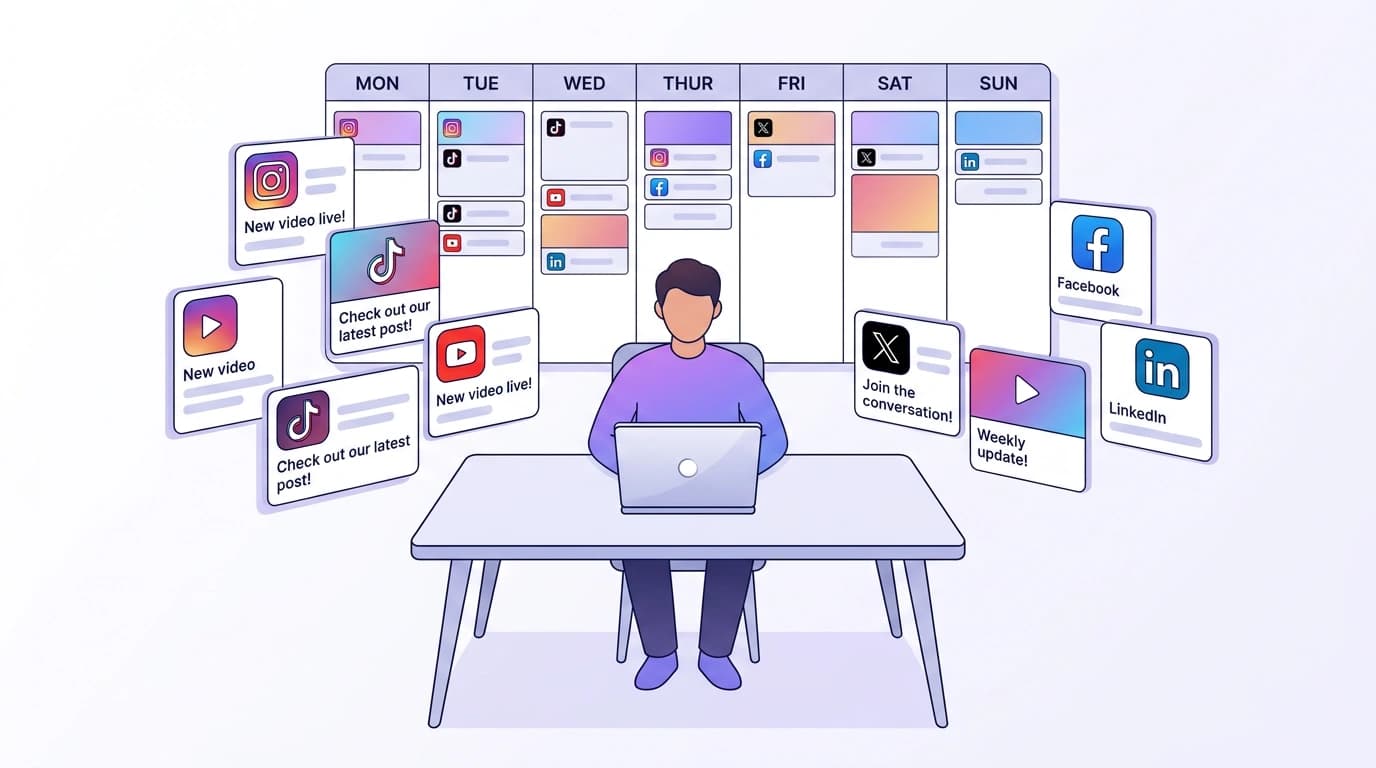
Write the idea one time. Let the caption adapt to each platform automatically instead of rewriting it by hand. Generate the image and have it fit every feed without you cropping anything. Line the whole week up on a content calendar and let it publish itself at the right time to every platform at once. Keep your brand voice steady by saving it once instead of re-summoning it in your head for every post.
That's the entire reason PowerPost exists. It takes the parts that ate that 7-to-12-hour table and folds them into a single pass: AI captions and images, multi-platform publishing to Instagram, TikTok, X, Facebook, and YouTube, and a content calendar so you're not personally hitting publish at 6 p.m. on a Tuesday. The creative part stays yours. The busywork stops being your problem.
FAQ
How many hours a week should a small business spend on social media?
Realistically, 3 to 5 focused hours a week is plenty to stay consistent if you're using tools that handle scheduling and cross-posting. The businesses burning 10-plus hours are almost always doing manual work that software could absorb, not doing more strategy.
Does scheduling posts actually save time?
Yes, and it's the highest-return change you can make. Scheduling turns publishing from a live task you interrupt your day for into a batch you knock out once. Plan a week of posts in one sitting and you routinely save several hours over posting live, one platform at a time.
What takes the most time in social media management?
Content production, mainly writing captions and making or resizing images. Across most surveys it's 40 to 70% of total social media time. It's also the part AI tools have gotten genuinely good at speeding up, which is why it's the first place to look for hours to reclaim.
Can AI really cut down social media posting time?
For the repetitive parts, yes. Drafting a caption, adapting it per platform, generating images, and auto-publishing on a schedule are all things AI and automation handle well now. What it won't do is have the taste or the idea for you, and honestly, you don't want it to.
So here's the real question. Of the 7 to 12 hours you'll spend on posting this week, how many are actually creative, and how many are just you doing a robot's job by hand? Count them once. That's usually the moment people decide to stop.